We just saw that the cosmos builds depth. But how does it do so?
It divides one thing into two things.
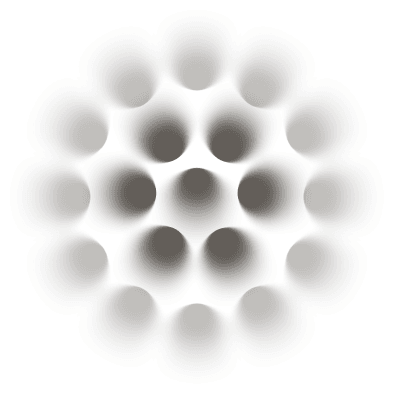
We might call it exploration. You can use this image to the left as a template for seeing evolutionary exploration anywhere: in a company whose functions have grown too fused to develop; in a relationship where two people need to find their own edges before they can truly meet; in geopolitics where entire international alliance networks break apart to allow for novel networks to form; in a field of knowledge whose most important discoveries came after it broke free from its parent discipline.
The one-becoming-two pattern is not special to biology. It's the rhythm through which the cosmos develops.
From cells dividing to a child discovering her own feelings are distinct from her mother's, the world grows through distinction—not fragmentation, but the kind of splitting that makes genuine development possible. To begin to see evolutionarily is to feel where something is ready to become more than it is: to sense the fused edges that are waiting to find their own names, and the divided things that are reaching, across their differences, toward a new and more spacious wholeness.
We just saw that the cosmos builds depth. But how does it do so?
It divides one thing into two things.
We might call it exploration. You can use this image to the left as a template for seeing evolutionary exploration anywhere: in a company whose functions have grown too fused to develop; in a relationship where two people need to find their own edges before they can truly meet; in geopolitics where entire international alliance networks break apart to allow for novel networks to form; in a field of knowledge whose most important discoveries came after it broke free from its parent discipline.
The one-becoming-two pattern is not special to biology. It's the rhythm through which the cosmos develops.
From cells dividing to a child discovering her own feelings are distinct from her mother's, the world grows through distinction—not fragmentation, but the kind of splitting that makes genuine development possible. To begin to see evolutionarily is to feel where something is ready to become more than it is: to sense the fused edges that are waiting to find their own names, and the divided things that are reaching, across their differences, toward a new and more spacious wholeness.