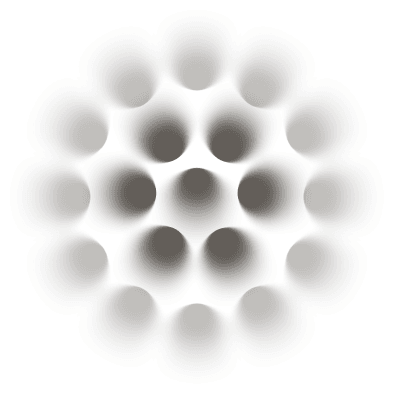
To the left, a perspective carousel where each slice is unique relative to the others. The Perspective lens reminds you that because there is no view from nowhere—only views from somewhere, each a partial window into a much larger reality—everyone’s view discloses some aspect of the bigger picture.
The position you look from shapes what shows up as visible, what recedes into background, and what disappears entirely. There is no vantage point outside all vantage points. Every view—including the view that tries to take in all views—is itself a view from somewhere.
In physics, motion and even time depend on the observer’s frame of reference. In biology, a bat, a bee, and a human inhabit the same environment but live in different perceptual worlds—ultrasound, ultraviolet, and visible light. In cognition, developmental psychology shows that children and adults literally construct different “worlds” from the same events. In culture, languages carve up reality in divergent ways, making some distinctions obvious to one group and nearly invisible to another.
Reality doesn’t change in each case, but the world enacted by the experiencer does—different vantage points enact different worlds.
This is not relativism: different vantage points can contain varying levels of truth, accuracy in apprehension of reality, assessments of value, comprehensions of complexity, and appreciations of beauty. But because every vantage point contains some partial truths, it is realism about situatedness.
Perspectival knowing acknowledges that the cosmos is too vast, layered, and dynamic to be captured by a single vantage point. A new story of wholeness emerges precisely because no single tradition, discipline, or worldview can fully see the whole (including the new story itself).
Instead, wholeness becomes visible only when we can hold multiple standpoints at once—honoring their limits, discerning their gifts, and seeing how each reveals a different facet of the real.
But when we hold extraordinary openness to differing perspectives in an ongoing commitment, we build capacity to see and take perspectives that transcend narrowness without abandoning rigor. Reality is never wrong, so what am I not seeing here?
When you understand that every view—including your own—is both real and partial, you become less interested in being right and more interested in seeing more. It invites you into intellectual humility, deeper compassion, and a more accurate understanding of the world beyond your own.
This gives access to a very powerful set of skills: the ability to consciously shift perspectives, integrate them, and construct a more complete view of the whole.
Other people no longer feel like strangers.
Different cultures no longer feel foreign.
Odd customs and values no longer feel odd.
The universe increasingly feels not just like home, but like self: the universe is in me.
As you move through the touch points to the left, notice how each shift reveals something new while obscuring something else. This is Perspective in action: reality seen not as a single frame, but as a constellation of vantage points—each incomplete on its own, yet together forming a richer, more faithful picture of the world you inhabit.